The short version
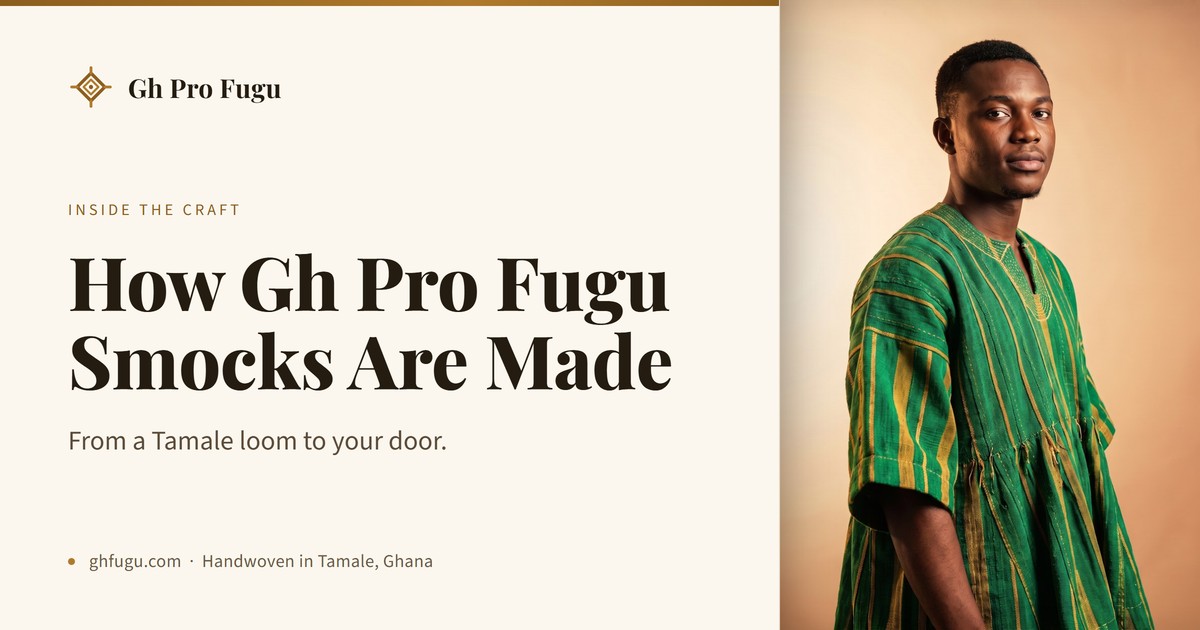
A fugu smock is made by weaving cotton into ribbons about four inches wide on a hand loom, cutting those ribbons into lengths, and sewing them together edge to edge by hand until there is enough cloth for a garment. A tailor then cuts and finishes the smock and closes the hem by hand. Nothing in the process is mechanised. The plaid pattern everyone recognises is not printed on. It is what happens where the strips meet.
A plain smock is a few days of work. The most elaborate is three weeks.
Cotton to yarn
It starts in the fields of the northern savannah, where cotton has been grown for as long as anyone has kept a record of it.
Traditionally the raw cotton was cleaned by hand, the seeds picked out, then bowed and rolled and spun on a hand spindle, almost always by women. Spinning is the invisible half of the tradition. It rarely makes it into photographs and it is the part that has receded fastest, because industrially spun yarn is available, consistent and cheap, and most weaving towns now buy at least some of what they use.
Hand-spun yarn is uneven in thickness. That unevenness is what gives old strip cloth its texture, the slight irregularity across the surface that no power loom reproduces because a power loom is built specifically not to.
Dyeing happens at the yarn stage, before weaving. This matters and it is the fastest way to understand what you own. A dyed check is dyed before it exists as cloth. In indigo country the yarn goes into the vat, comes out, oxidises from green to blue in the air, and goes back in, over and over until the depth is right. Only then does anyone start weaving. Printing a pattern onto finished fabric is a completely different, much faster industry, and it is what most cheap imitation smocks are.

The narrow-strip loom
The loom is a light wooden frame, usually set up under a tree or a shelter rather than in a building. The weaver sits at one end. The warp threads stretch away from him, often for many yards, weighted at the far end by a stone or a sled that is dragged forward as the work advances.
He works the heddles with his feet and passes the shuttle by hand. The web he produces is a continuous ribbon roughly four inches wide.
Four inches. That is the constraint the entire garment is designed around. Every visual characteristic of a fugu smock, the check, the stripes, the way the pattern steps across the body, exists because a hand loom in the savannah produces a narrow ribbon and a person has to join many of them to clothe anybody.
Once you know that, you can never look at a smock the same way. You start counting seams.
How many strips make a smock
Enough that the answer surprises people.
Take a smock measuring 50 to 56 inches across the chest, which is our standard One Size. That is the front and back both, so the flat cloth before assembly is wider still. At roughly four inches per strip, allowing for the seam overlap, a single smock body needs somewhere in the region of a dozen strip-lengths, and that is before the sleeves.
Our denser pieces use narrower strips, which means more of them, which means more loom time and more seams to sew and match. That is the whole economics of the garment in one sentence. You are not buying fabric. You are buying the number of times a person joined two pieces of it.
Turn any smock inside out and count. It is the most reliable test there is. See how much a fugu smock costs for how strip count maps onto price.
The towns that weave
The tradition is not spread evenly across the north. It concentrates in specific places, and the differences between them are legible in the cloth.
Daboya
About 60km west of Tamale, in the Gonja area of the Savannah Region, and the district capital of North Gonja. Daboya is the indigo town.
Its organic indigo dyeing and weaving tradition runs back over three centuries, and local accounts trace the craft to migration from Mende, in what is now Mali. Weaving is not a sideline here. Alongside farming and fishing, it is one of the three things the town does, and published research puts roughly 75 percent of Daboya's men in fugu production.
Daboya cloth is the deep blue and blue-white strip cloth that most people are actually picturing when they picture a Ghana smock. If you own a classic indigo batakari, its ancestry is here.
The industry has real difficulties. Fading and the smell that organic indigo leaves in freshly dyed cloth are both documented as commercial problems for Daboya weavers, and it is the sort of thing a brand should say out loud rather than pretend away. The smell fades with washing. The character does not.
Yendi
The seat of Dagbon, in the Northern Region. Yendi carries the Dagomba weaving and tailoring lineage and the naming system that comes with it: the sleeveless yansichi, the sleeved bingmaa, the wide-sleeved kpaakuto, and the chiefly kparugu worn at enskinment.
This is where the relationship between the garment and rank is most developed. In Yendi a smock is not only clothing. See our types of Ghanaian smock guide for the full naming system.
Tamale
The commercial heart of the north and the largest city in the region. Much of the trade passes through Tamale even when the weaving happened elsewhere, and it is where weavers, tailors and buyers meet.
Bolgatanga
Upper East, and internationally famous for basketry rather than cloth. The weaving is there too, and Bolga cloth tends lighter and brighter than the heavy indigo of Gonja, suited to the hotter, drier air.
We work with more than 200 master weavers across Tamale, Yendi and Bolgatanga. That is where the 31 colorways on this site come from.
Which town weaves the most
People search for this directly, so here is a direct answer, with the limits of it stated.
There is no official production census of Ghanaian smock weaving, so nobody can name a most productive town with data behind it. Anyone who gives you a confident ranking has made it up.
What can be said: Daboya is the town most consistently named as the centre of the craft, and it is the only one with a published figure attached, with research reporting around 75 percent of its men engaged in fugu production. That is a proportion of a small town, not a national output total. Tamale is the largest commercial centre and the greatest volume of finished smocks changes hands there, though much of what passes through Tamale was woven somewhere else. Yendi carries the deepest tradition of ceremonial and chiefly forms.
Different questions, different towns. If you want to know where the craft is densest, it is Daboya. If you want to know where the trade is biggest, it is Tamale.
Joining the strips
The weaver hands over ribbon. Somebody has to turn it into cloth.
The strips are cut to length, laid out side by side, and joined with a fine hand-stitched seam. This is where the good work separates from the fast work.
A senior tailor lays the strips so the pattern continues across every join. Follow one horizontal band with your finger and it should step from strip to strip without a break, all the way across the chest. On rushed work the bands jump at every seam and the garment looks slightly wrong from across a room in a way that is hard to place until you know what you are looking at.
Nobody masters this quickly. It is the skill people spend twenty years acquiring, and it is not a feature you can market easily, which is precisely why so much of the market ignores it.

The hem, and why it is never fringed
A fugu smock hem is woven closed and finished neatly.
This needs saying because a great many product photographs online show a raw fringed or frayed hem, and image-generation tools default to it as well. It is wrong. A northern tailor finishes the bottom of a smock cleanly. A fringe means the garment was cut from cloth and left unfinished, and if that is what arrived, that is what happened.
If you take one visual test away from this article, take that one. Neatly woven hem, every time.
Embroidery and inlay at the top tier
Two more processes sit on top of the base garment, and they are what separates our Presidential Elite pieces.
Hand embroidery at the neck and chest, worked stitch by stitch after the garment is assembled. The neckline motifs on a ceremonial smock are entirely hand-stitched.
Supplementary-weft inlay happens during weaving, not after. The weaver introduces extra threads across the warp to raise a motif or a band, so the pattern is built into the structure of the cloth rather than applied to it. Metallic and gold threads go in this way. It is slow, it demands planning several inches ahead, and an error means unpicking woven cloth.
That is why the gold pieces cost $225 to $250 and why none of them can be made quickly. See our gold-accented collection for the finished result.

How long each tier takes
Heritage Classic, $155 to $179. Plain grounds, lower strip count, no inlay. Days of work, and normally in stock.
Signature Profile, $185 to $215. Higher strip count, finer check, careful seam matching. More loom time and considerably more tailoring.
Presidential Elite, $225 to $250. Densest strip count, hand embroidery, inlay, gold thread. Ten to twenty-one days of craftsmanship per garment.
We say that before you order rather than after, because it is a real constraint. If you have a wedding in three weeks, a Presidential Elite piece is tight. Order it now or choose from the other two tiers — see fugu smocks for weddings for the full lead-time guidance.
Every smock ships from Ghana with a certificate of authenticity naming the piece.
Questions about the process
How is a fugu smock made?
Cotton yarn is dyed, woven into four-inch strips on a hand loom, cut to length, and hand-sewn edge to edge into cloth. A tailor then cuts and finishes the garment and closes the hem by hand.
How long does it take to make a fugu smock?
A plain smock takes days. Our Presidential Elite pieces, with hand embroidery and gold-thread inlay, take 10 to 21 days each.
Where are Ghanaian smocks made?
In Northern Ghana. Daboya in the Savannah Region is the centre of the indigo tradition, Yendi is the seat of the Dagomba tradition, Tamale is the commercial hub, and Bolgatanga weaves a lighter cloth.
Which place in Ghana weaves the most smocks?
There is no official production data. Daboya is the town most often named as the centre of the craft, with research putting roughly 75 percent of its men in fugu production. Tamale handles the most trade.
Why is the pattern on a batakari not printed?
Because it is not applied to the cloth. The check appears where woven strips are joined, from the crossing of warp stripes and weft bands. Turn a real smock inside out and you can count the seams.
See the work these looms are producing right now
Each smock is made-to-order by master weavers in Northern Ghana.
Shop 31 hand-woven fugu smocks