The short answer
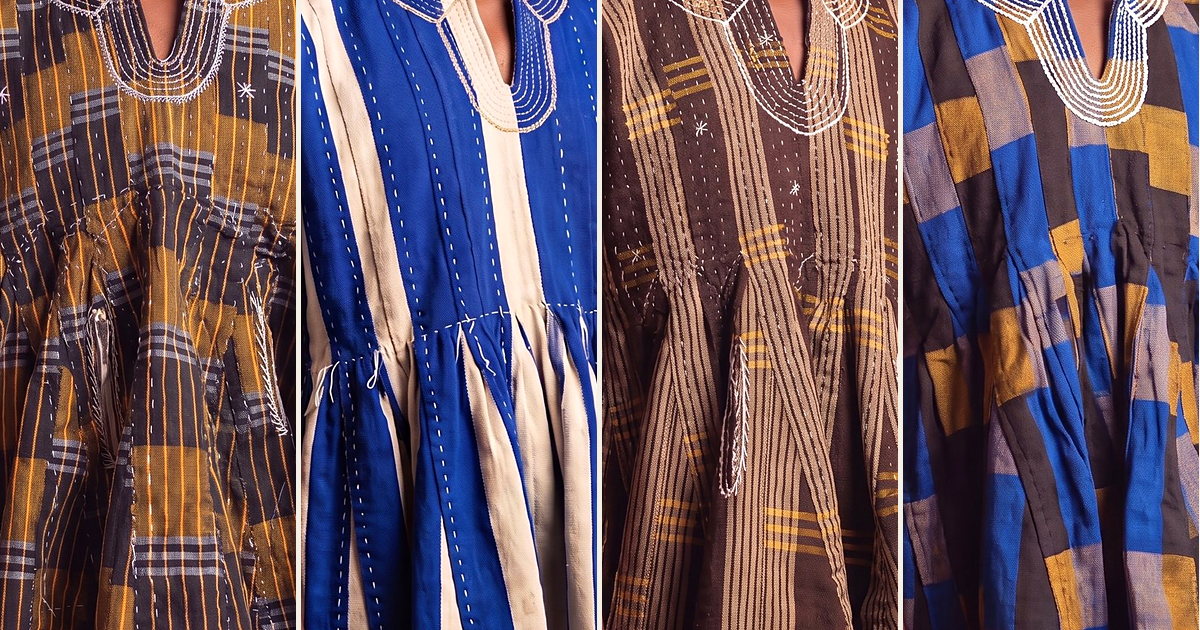
Ghanaian smocks divide first by sleeve. There is the sleeveless smock, worn alone or as an underlayer. There is the standard sleeved smock, which is what most people own and what most shops sell. There is the wide-sleeved ceremonial smock, cut with enormous sleeves that fall in folds. And there are the chiefly forms, worn at enskinment and by title holders, which are not sold to the public. Pattern is a separate axis: the check comes from how the woven strips are joined, and its scale and color locate the garment regionally.
That is the map. The rest of this explains it.
Why the names change depending on who you ask
Before the types, the words, because this is where most articles on the subject go wrong.
There is no single Ghanaian name for this garment. Every group that wears it has its own.
- Batakari entered wide use through Asante speakers and is now the default word across much of the country.
- Fugu has Mossi roots and is the term that dominates in the south and on export listings, including ours.
- Bingmaa is Dagbani, the language of the Dagomba, in Dagbon.
- Bana is what Mamprusi speakers say.
- Banaa is the Kusaal word.
- Dansika is Frafra.
- Ghana smock is the English label, used mostly by museums, retailers and buyers outside the country.
They are not brands or grades. They are seven communities naming the same cloth. If a seller tells you a "batakari" and a "fugu" are two different products at two different prices, that seller is either confused or counting on you being.
More on the naming: fugu vs batakari vs dansiki.
The loom decides the pattern
You cannot understand smock patterns without understanding the loom, because the pattern is not a design choice laid on top of the cloth. It is a consequence of how the cloth is built.
Northern Ghana weaves on a narrow-strip loom. It produces a continuous ribbon of cotton roughly four inches wide. Not four feet. Four inches. Everything else follows from that limit.
To clothe a body you need many strips. The weaver produces yards of ribbon, a tailor cuts it into lengths and sews them together edge to edge by hand, and the flat cloth that results is then made into a garment. Each strip carries its own stripes running along its length. Lay a dozen side by side, and the horizontal bands in the weft cross those vertical stripes.
That crossing is the plaid. The famous batakari check is the geometry of assembly.

Which means the visual variables are not "designs" in a catalogue sense. They are:
Strip width and count. Narrower strips mean more of them, more seams, a finer and denser check. This is the single clearest indicator of how much labor is in a garment.
Stripe spacing within the strip. Set by the weaver at the warp, before a single pick of weft goes through. It is decided days before the garment exists.
Ground color. Undyed cream, indigo blue, or a dyed color.
Whether the check is matched at the seams. On good work the pattern steps continuously across every join. On fast work the stripes jump at each seam. Look at this before you look at anything else.
Supplementary-weft inlay. Extra threads worked in during weaving to raise a motif or a band, including metallic thread. Slow, skilled, and the reason the top tier costs what it costs.
Full detail on the making: how a fugu smock is made.
The named Dagomba smock types
Dagbon has the most developed naming system, and its terms are the ones most often quoted, so they are worth setting out properly. These names are Dagbani.
Yansichi, also written dansichi. The sleeveless smock. Straight-cut, open at the arms, and the most everyday form of the garment. It is worn alone in heat, or layered under a larger smock.
Bingmaa. The sleeved smock, and the base form for the whole family. The name means roughly "the short one" in Dagbani, and the length falls to mid-thigh. Because it is the shorter garment, it is also the one worn underneath a larger ceremonial smock. Confusingly, bingmaa is also used as the general Dagbani word for a smock of any kind, which is why you will see it defined both ways.
Kpaakuto. The wide-sleeved smock. The sleeves are cut long and full, so the garment falls in heavy folds and moves dramatically. This is the form worn for ceremony, dance and display, and it is what most people picture when they picture a chief at a durbar.
Yebili. Associated with title holders rather than the general public.
Kparugu. The chief's smock, worn at enskinment. This is regalia. It is not a retail item and any shop offering you one is selling you a costume.
Saandan Yibu also appears in the Dagomba classifications.
A necessary caution. Documented lists of these types vary between sources, and definitions shift between communities and generations. The safest position, and the one we hold: sleeve treatment and length are the reliable distinctions, the ceremonial and chiefly forms carry rank, and anyone claiming a single authoritative taxonomy of Ghanaian smocks is overstating what is actually agreed.
Regional differences
Four traditions, four looks, and to somebody from the north they are as legible as an accent.
Dagomba, centred on Yendi and Tamale in the Northern Region. The most elaborate naming system, and the deepest connection between smock form and rank.
Gonja, centred on Daboya, about 60km west of Tamale. This is the indigo country. Daboya's organic indigo dyeing and weaving tradition runs back more than three centuries, locally traced to migration from Mende in present-day Mali, and roughly three quarters of Daboya's men work in fugu production. Daboya cloth is the deep blue and blue-white strip cloth that defines the classic look of the garment.

Mamprusi, in the north east, where the garment is bana.
Frafra, around Bolgatanga in the Upper East, where it is dansika. Bolgatanga is internationally better known for basketry, but the weaving is there, and its cloth tends lighter and brighter.

Where our three tiers fit
Honest placement, because this matters if you are buying.
Everything Gh Pro Fugu sells is the sleeved everyday form. We do not sell chiefly regalia and we are not going to start. Those garments belong to specific people in specific ceremonies and selling one to a stranger would be a costume shop's business, not ours.
Within that, our tiers map onto labor, not onto rank.
Heritage Classic, $155 to $179. Eight colorways. Plain grounds and simple two-tones, lower strip count, no inlay. The garment in its most straightforward form.
Signature Profile, $185 to $215. Twelve colorways. Higher strip count, finer check, careful pattern matching across the seams. This is where the patterned pieces live.
Presidential Elite, $225 to $250. Eleven colorways. Densest strip count, hand embroidery at neck and chest, supplementary-weft inlay, gold-thread work. Ten to twenty-one days of one person's hands.

How to choose one
Three questions get most people there.
What is it for? Everyday and general wear, take a plain ground: brown, grey, black, white. A wedding or a durbar, go to the patterned or gold-accented end and read our wedding guide for the color etiquette, because it is real.
How hot is it where you are? The sleeveless form and the lighter Bolgatanga-style cloth suit heat. If you are wearing this in Toronto in November, weight is your friend.
How much pattern can you carry? A dense check is a lot of visual information. If you have never worn a smock, start plain and build.
And whichever you pick: One Size, fitting a 36 to 52 inch chest, with free custom sizing if you fall outside that. Shop all 31 colorways.
FAQ
What are the different types of Ghanaian smock?
By sleeve: sleeveless (yansichi), standard sleeved (bingmaa), and wide-sleeved ceremonial (kpaakuto). Plus chiefly forms such as kparugu, worn at enskinment, which are not sold commercially.
What is the difference between a batakari and a fugu?
None. They are two names for the same garment, from different language communities. Batakari came through Asante speakers, fugu has Mossi roots.
What do batakari patterns mean?
The check comes from joining narrow woven strips, so pattern reflects strip width, stripe spacing and ground color. Those vary by region and by weaver, which makes pattern a marker of origin more than a coded message.
Which region makes the best Ghanaian smock?
There is no best. Daboya is known for indigo, Yendi and Tamale for the Dagomba tradition and its ceremonial forms, Bolgatanga for lighter cloth. Judge the individual garment: strip count, matched seams, neatly woven hem.
Are Ghanaian smocks unisex?
Yes. Men and women wear the smock across Northern Ghana. Our catalogue is One Size, cut generously, with free custom sizing.
See the work these looms are producing right now
Each smock is made-to-order by master weavers in Northern Ghana.
Shop 31 hand-woven fugu smocks and batakari